Start with 2.5 to 5 mg of THC. Wait a full two hours before you even think about taking more. That is the whole framework, and if you stop reading here you are already ahead of most people who’ve had a rough night with edibles.
The problem isn’t that edibles are unpredictable. The problem is that people don’t account for how fundamentally different the delivery mechanism is. I’ve watched Ted, my college roommate, eat a whole 10 mg gummy on an empty stomach, feel nothing for ninety minutes, and then eat a second one. Two hours later he was face-down on the couch convinced the ceiling was watching him. Don’t be Ted.
Your Liver Runs the Show, Not Your Lungs
When you smoke or vape cannabis, THC enters your bloodstream through your lungs and reaches your brain in minutes. Edibles take a completely different path. Your digestive system breaks the food down, your small intestine absorbs the cannabinoids, and then the liver processes everything before it hits your bloodstream.
That liver pass converts delta-9-THC into 11-hydroxy-THC, a metabolite that crosses the blood-brain barrier more efficiently than delta-9 and produces a longer, more body-heavy experience. Research published in the British Journal of Clinical Pharmacology confirms that 11-hydroxy-THC reaches peak plasma concentrations later than delta-9-THC after oral ingestion, explaining both the delayed onset and the more intense subjective effects many people report.
This is why onset timing for edibles ranges from 30 minutes to 2 hours, compared to 5 to 15 minutes for inhalation. The potency difference between the two delivery methods is also why dosing guidance that works for smoking does not translate to edibles at all.
The Dosage Tiers: Where You Fit on the Scale
These tiers are based on the pharmacological literature on THC dose-response relationships and widely used in regulated markets. They assume you have not eaten in the last two hours and that you are working with a standard oral edible.
| Dose (THC) | Experience level | Expected effects |
|---|---|---|
| 1 to 2.5 mg | Microdose | Subtle mood lift, reduced tension, no obvious impairment |
| 2.5 to 5 mg | Beginner | Mild relaxation, light euphoria, enhanced focus for some |
| 5 to 10 mg | Occasional consumer | Moderate euphoria, noticeable body relaxation, altered time perception |
| 10 to 20 mg | Regular consumer | Strong euphoria, deeper body effects, may impair coordination |
| 20 to 50 mg | High tolerance | Very strong effects, significant cognitive impairment |
| 50 mg and above | Experienced only | Intense, potentially uncomfortable, not recommended without established tolerance |
Most regulated-market single-dose edibles are formulated at 5 or 10 mg per piece. The FDA has noted that consumers frequently underestimate the potency of THC-infused products compared to smoked cannabis, particularly first-time users. Start at the low end of the range for your experience level, not the high end.
Five Things That Actually Change How Hard an Edible Hits
The dosage tiers above assume an average body and average conditions. These five variables can shift your effective dose significantly in either direction.
Body composition. Fat tissue stores THC because cannabinoids are lipophilic. Clinical pharmacokinetics research shows that individuals with higher body fat may experience a delayed but prolonged effect as THC releases slowly from adipose tissue. Lean individuals may feel a sharper, faster onset.
Food in your stomach. Eating a full meal before taking an edible slows absorption because your digestive system is already occupied. Taking an edible on a fully empty stomach accelerates onset but can also increase peak intensity. A light meal one to two hours before is the practical middle ground.
Metabolism and liver function. CYP2C9 and CYP3A4 are the liver enzymes primarily responsible for metabolizing THC. Genetic variants in these enzymes are real and documented. Fast metabolizers feel effects sooner and shorter; slow metabolizers may have a delayed onset with longer duration. You cannot test this without a lab, but you can learn your pattern over a few sessions.
Cannabis tolerance. Regular consumers develop tolerance at the CB1 receptor level. What produces strong effects in a beginner may produce minimal effects in someone who uses cannabis daily. If you have an established tolerance and the 5 mg tier feels weak, move up incrementally rather than jumping to the top of the chart.
The specific edible type. Sublingual products (tinctures held under the tongue) partially bypass first-pass metabolism and hit faster. Beverages often absorb faster than solid foods. Capsules and hard candies digest at different rates. Your specific product matters, not just the milligram count.
How to Re-Dose Without Making a Mistake
The two-hour rule exists because edible onset is genuinely unpredictable. A 2021 review in Cannabis and Cannabinoid Research found that onset variability in human subjects ranged from 30 minutes to over two hours for identical oral doses under controlled conditions. The variation isn’t in your head. It’s pharmacological.
The practical protocol: take your starting dose, set a two-hour timer, and do not touch the package again until it goes off. When the timer ends, assess honestly. If you feel nothing, you can take another half-dose and wait another hour. If you feel mild effects, hold where you are and let it peak. If you feel moderate-to-strong effects, you’re done for the session.
The mistake people make is assessing at 45 minutes and concluding the edible isn’t working. It almost always is. If you’re consistently feeling nothing at the two-hour mark with standard doses, read our guide on why edibles sometimes don’t kick in and what to do about it.
When You’ve Taken Too Much
If you’re reading this section because it’s already happened, take a breath. No one has ever died from cannabis overconsumption. The experience is uncomfortable and sometimes frightening, but it is temporary.
The most effective immediate steps are finding a calm, familiar environment, having water nearby, and reminding yourself that it will pass. CBD may blunt some of the anxiety associated with THC overconsumption. Black pepper, frequently cited in anecdotal cannabis culture, has limited but some preliminary scientific interest as a terpene-based modulator.
For a complete breakdown of what actually works and what doesn’t when you’ve taken too much, our full guide on how to stop being high covers every step in order of effectiveness.
Onset Differences Across Edible Types
Not all edibles are created equal from a pharmacokinetics standpoint. The delivery format matters as much as the milligram count.
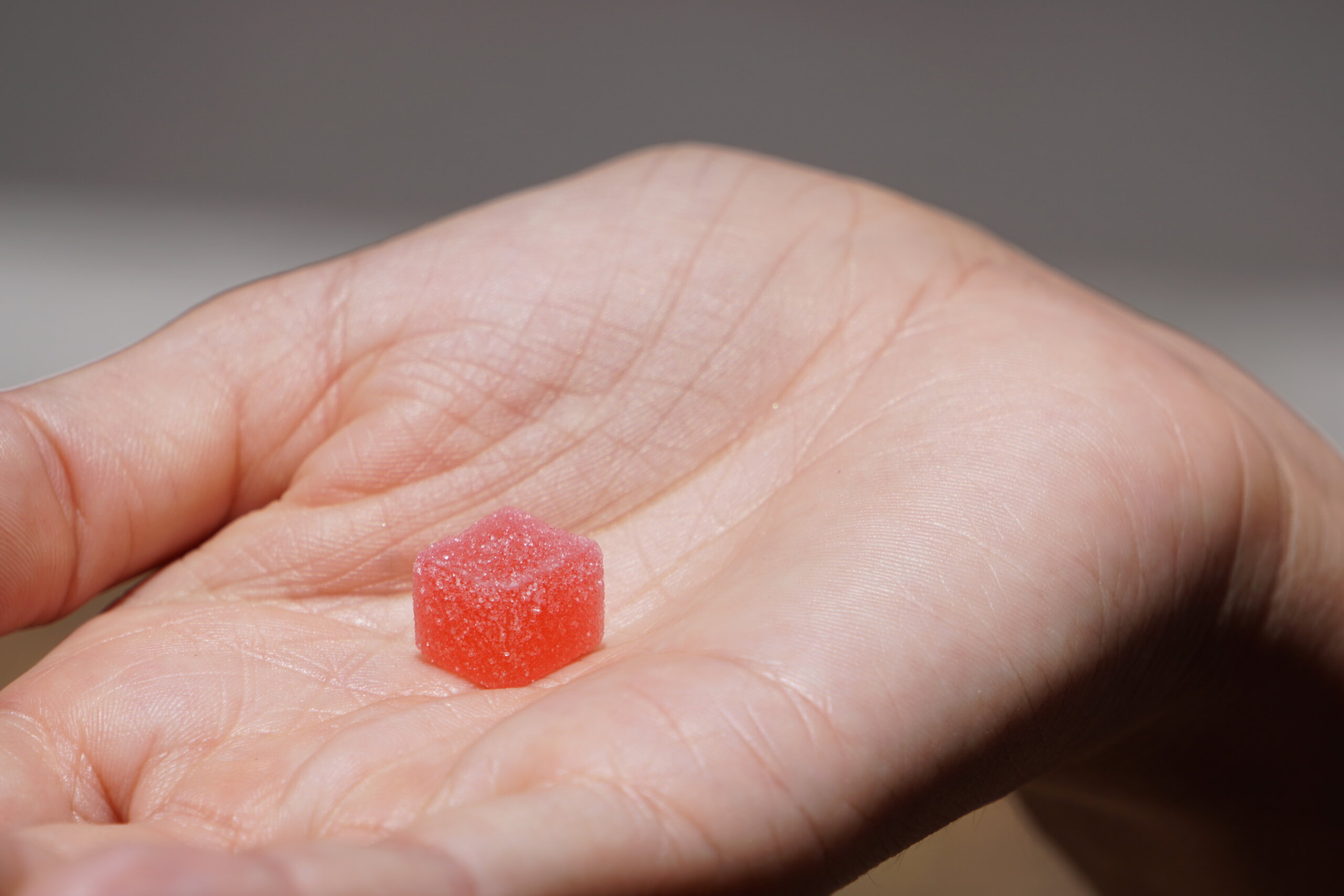
Gummies. The most common format. Gelatin-based, absorbed through the digestive tract. Typical onset 45 to 90 minutes. Consistent and predictable across batches when quality-manufactured.
Chocolates. Fat content in chocolate can accelerate THC absorption because THC is lipophilic. Some consumers report faster onset than comparable-dose gummies, though this varies by product.
Cannabis-infused beverages. Onset is often faster than solid edibles, sometimes 20 to 45 minutes. Newer nano-emulsified formulations reduce particle size and improve absorption speed. Read the label for onset guidance specific to the product.
Capsules and gel caps. Behave similarly to pharmaceuticals. Onset depends on stomach contents and digestion rate. Often 60 to 90 minutes. More consistent dosing because there is no food matrix to interact with.
Sublingual tinctures. Technically not edibles but often grouped with them. Held under the tongue, a portion absorbs directly through oral mucosa. Partial first-pass bypass means faster onset, sometimes 15 to 45 minutes. Swallowed portion follows the standard edible pathway.
How to Dose an Edible for the First Time: The Four-Step Protocol
First-time dosing comes down to four decisions made in sequence. Get these four right and you’ve removed almost all the variables that lead to a bad experience.
Step 1: Choose 2.5 mg. Not 5 mg. Not 10 mg. The default starting dose for a genuine first-timer is 2.5 mg of THC. If you can’t find a product at that dose, buy a 5 mg product and eat half. The goal of the first session is not to get high. It’s to learn how your body responds.
Step 2: Eat a light meal first. A small meal 60 to 90 minutes before your edible slows absorption slightly, which means a more gradual onset and less chance of a sharp, disorienting spike. Do not eat the edible on a completely empty stomach your first time.
Step 3: Set a two-hour timer and wait. Put the package out of reach. The timer is non-negotiable. When people skip this step, they redose too early and that is almost always the source of “edibles hit me way too hard” stories.
Step 4: Assess and decide. When the timer ends, evaluate your state honestly. Mild effects: hold. No effects: optional half-dose re-up. Any anxiety or discomfort: you are already in it and adding more will not help. The next session, you’ll have real data on where your baseline is.
Frequently Asked Questions
How many mg should a first-time edible user take?
Start at 2.5 mg of THC. If you can only find products at 5 mg or 10 mg, take half the lowest available dose. The goal of the first session is calibration, not a strong effect.
Why do edibles feel stronger than smoking the same amount of THC?
Because the liver converts delta-9-THC into 11-hydroxy-THC during first-pass metabolism. This compound is more potent, crosses the blood-brain barrier more effectively, and stays in your system longer than the THC you’d absorb through your lungs.
How long should I wait before taking a second edible dose?
Two hours minimum from your first dose. Onset can take up to two hours depending on your metabolism, stomach contents, and the specific product. Most redosing mistakes happen when people assess at 45 to 60 minutes and conclude the edible isn’t working.
Does body weight affect edible dosage?
Body composition affects the pharmacokinetics but not in a simple linear way. Higher body fat can mean a delayed onset and longer duration as THC stores and releases from adipose tissue. Body weight alone is not a reliable guide to dosage. Your cannabis experience level and tolerance are better predictors.
Can I build tolerance to edibles specifically?
Yes. Tolerance develops at the CB1 receptor level regardless of delivery method. If you consume cannabis regularly via any route, your effective edible dose will likely be higher than someone consuming cannabis for the first time. However, edible tolerance and inhalation tolerance are roughly equivalent since they share the same receptor pathway.
The single biggest variable in edible dosing is time. Give it two hours. I’ve never once met someone who regretted being patient with an edible. I’ve met plenty of people who regretted not being.