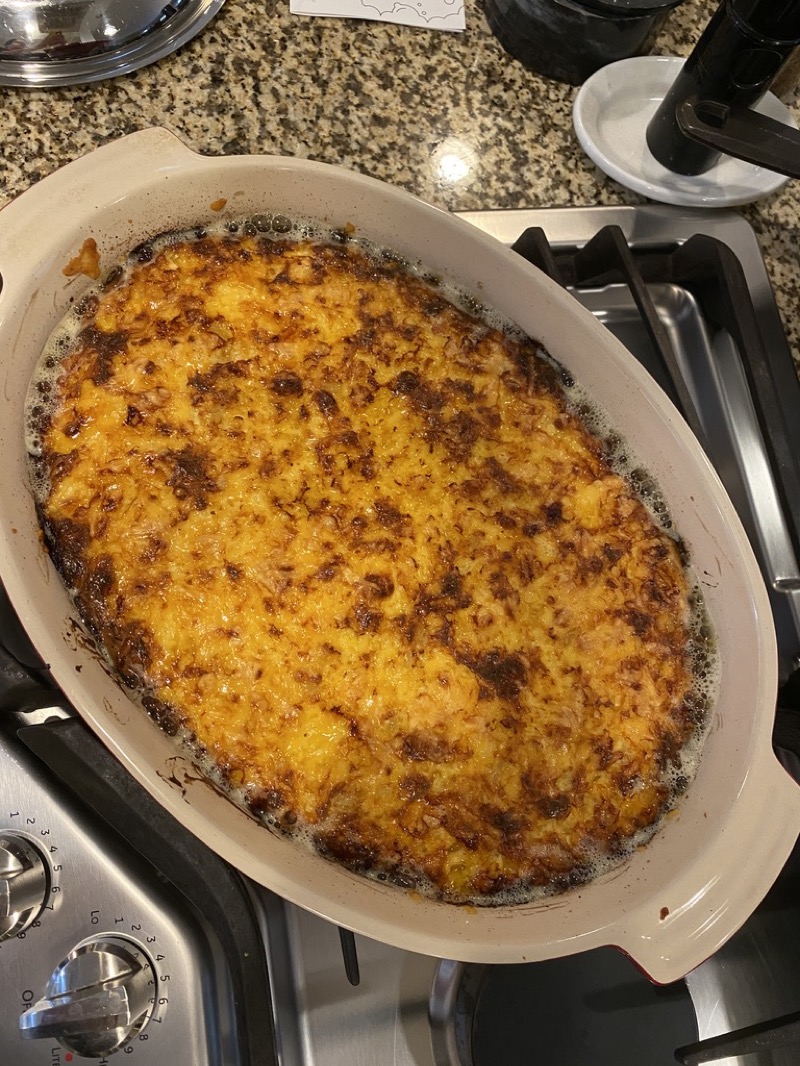
The first cannabis mac and cheese I ever made was the night Ted moved out of our college rental. He had spent four years subsisting on the boxed kind, the kind with the orange powder, and he had announced earlier that week that he was leaving for a software job in Austin and would not be eating boxed macaroni in his new adult apartment. So I made him a sendoff dinner. I had a half stick of cannabutter in the fridge from a small batch I had cooked the previous Sunday, dosed at about ten milligrams per tablespoon, and I knew he had to drive a U-Haul in the morning so I cut it to a two milligram microdose per portion. I built the bechamel with that cannabutter, stirred in two cups of sharp cheddar and a cup of grated Gruyere, baked it under panko, and we ate it on the kitchen floor surrounded by his packing boxes.
Ted, who never noticed anything, paused after the third bite and said, “This tastes like grown-up Kraft.” That was the highest compliment he had ever paid food. He drove the U-Haul fine the next morning and still asks for the recipe every time I see him. This is the savory move. The cannabutter matters. The cheese matters more.
The cannabutter ran loud that semester. Garlic Cookies decarbed at 240 for 40 minutes, gas and savory garlic over a basenote of damp earth honking out of the Tupperware every time we cracked the lid. Mac and cheese turns out to be the perfect savory cannabis vehicle. The dish is fat-rich on every axis, butter, milk, two cheeses, sometimes cream, which means the THC absorbs cleanly. The flavor profile is loud enough to mask any grassy notes from the cannabutter. And the format is portion-controlled in a way that brownies and gummies are not. You scoop a serving, you eat the serving, you know exactly what you took.
The Six Reasons. Why This Recipe Hits.
- Predictable per-serving dosing built into the recipe math, not eyeballed
- Real bechamel base, not a roux-free cheese melt that breaks under heat
- Two-cheese blend for stretch and sharpness, not one-note cheddar
- Stovetop or baked, your call, both versions written below
- The cannabutter is the only specialty ingredient, everything else is grocery store
- Leftover-friendly, the dish reheats with a splash of milk and stays creamy
The Cannabutter. Built Into the Mornay From Step One.
The active ingredient here is cannabutter, which carries decarboxylated THC suspended in milk fat. When you melt that butter into a roux, then whisk in milk and shredded cheese, the THC stays bound to the fat phase the entire time. There is no point in this recipe where you boil the cannabutter on its own or take it past the temperature where THC starts to degrade, which is roughly 320 degrees Fahrenheit per cannabinoid stability research published in Cannabis and Cannabinoid Research. The bake step happens at 375 degrees, but the cannabutter is fully suspended in the bechamel and shielded by the milk and cheese. Surface temperature on a covered casserole rarely exceeds the boiling point of the milk fraction. You will not lose meaningful potency.
The cannabutter on Ted’s last night was Garlic Cookies, decarbed at 240 for 40 minutes, gas and savory garlic over a basenote of damp earth, the kind of jar that honks the whole apartment out when you crack the lid. That savory profile was the giveaway that mac and cheese was the right vehicle. A loud, gassy, garlicky cannabutter wants a sharp cheddar and a Gruyere finish, not a sugar matrix. Match the strain to the dish. Garlic Cookies, GMO, Wedding Cake, anything in the gassy-savory wheelhouse, all do this job. Save the candy-grape and tropical-citrus profiles for the brownies and the gummies.
I dose this recipe at five milligrams of THC per serving, which is what California, Colorado, and most regulated markets define as a single adult edible dose per the California Department of Public Health edible regulations. Six servings, thirty milligrams total, three tablespoons of ten-milligram-per-tablespoon cannabutter, the rest regular butter. The math is laid out in the recipe card below. If your cannabutter is a different potency, swap the proportions to keep the per-serving dose the same. Do not push past ten milligrams per portion unless you and everyone at the table know exactly what you are doing.
The Method. Salt the Water Like You Mean It.
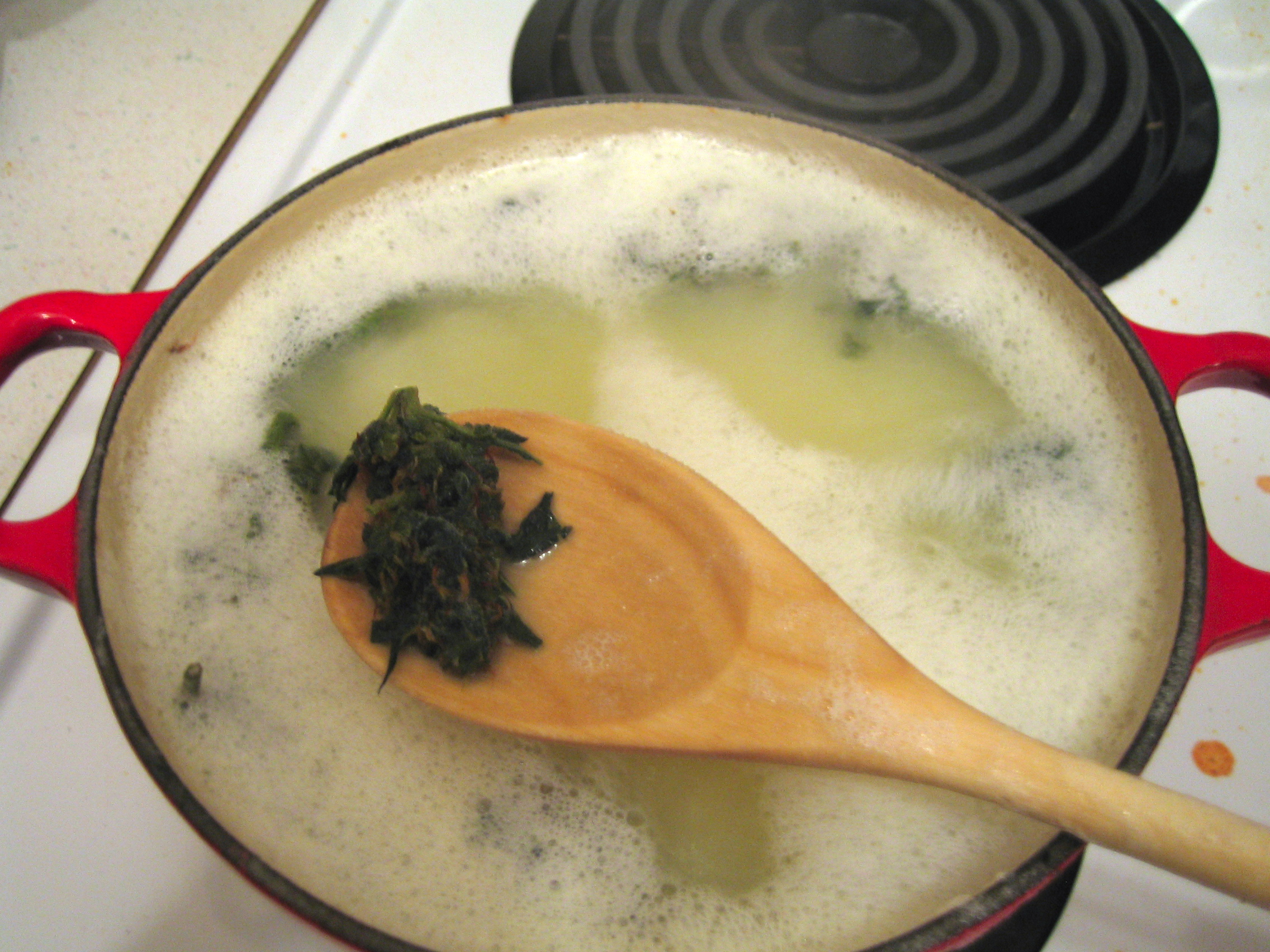
Salt a big pot of water like you mean it and bring it to a boil. Drop in a pound of dry elbow macaroni and cook it about two minutes shy of the package directions. You want it firm because it will keep cooking in the cheese sauce. While that goes, melt your butter mixture in a heavy saucepan over medium-low. Three tablespoons of cannabutter, three tablespoons of regular unsalted butter, side by side, swirling until the foam subsides.
Whisk in a quarter cup of all-purpose flour and let that toast for about ninety seconds. This is your roux. It should smell faintly nutty and look like wet sand. Pour in three cups of warm whole milk in a slow stream, whisking the whole time so the roux dissolves smoothly. Add a teaspoon of Dijon mustard, half a teaspoon of garlic powder, half a teaspoon of smoked paprika, a quarter teaspoon of cayenne if you like a little heat, a teaspoon of kosher salt, and a generous grind of black pepper. Bring it up to a gentle simmer, whisking, until it coats the back of a spoon. That takes about six to eight minutes.
Pull the pot off the heat. This is the critical move.
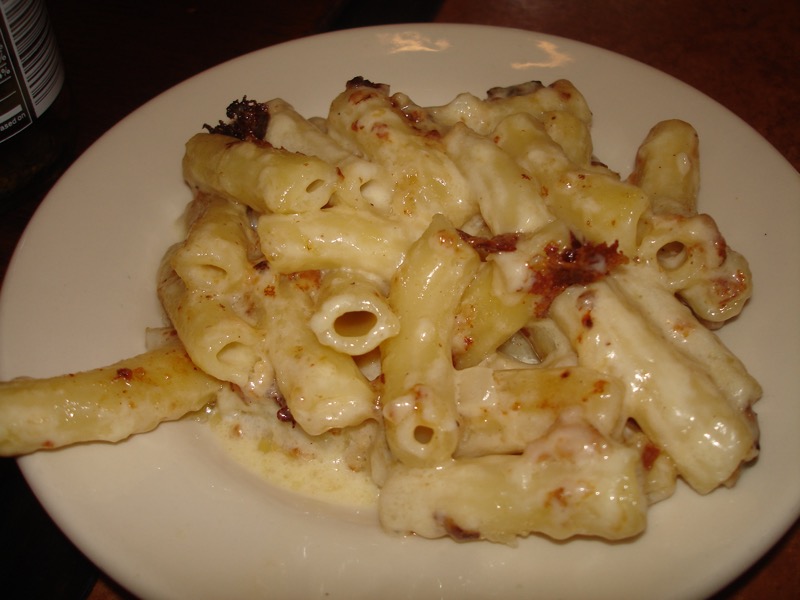
You must take the bechamel off direct heat before adding the cheese, because cheese added to a screaming-hot sauce breaks and goes grainy. Off-heat, whisk in two cups of shredded sharp cheddar and one cup of shredded Gruyere a handful at a time, letting each addition melt before the next. The sauce will thicken and turn glossy. Drain your macaroni, fold it into the cheese sauce, taste for salt.
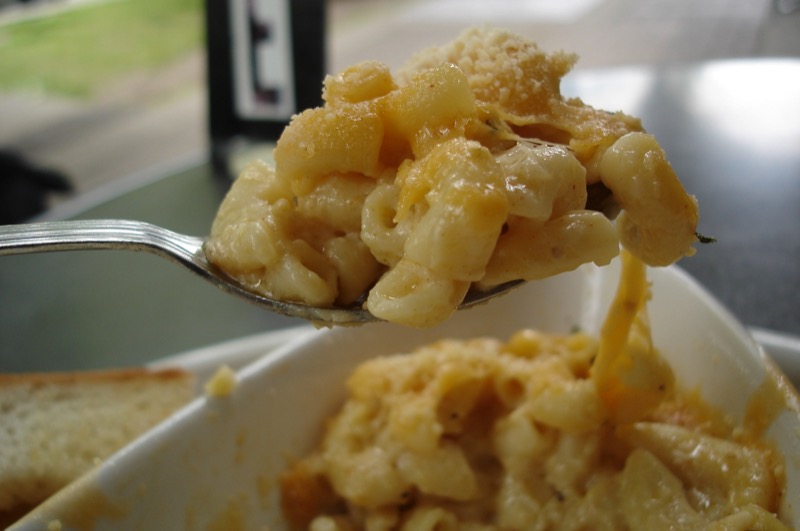
If you are stopping here, this is your stovetop version. Serve it immediately. If you want the baked version, transfer the whole thing to a buttered nine-by-thirteen casserole, scatter a half cup of panko tossed with two tablespoons of melted regular butter and a quarter cup of grated parmesan over the top, and bake at 375 degrees for twenty to twenty-five minutes until the top is golden and the edges bubble.
The Pro Tips. Six Levers That Actually Matter.
Shred your own cheese
Pre-shredded bagged cheese is coated in cellulose and potato starch to keep it from clumping in the bag. Those coatings interfere with melting and they make the sauce gritty. Buy block cheese and shred it on the large holes of a box grater. It takes four extra minutes and the texture difference is the whole game. America’s Test Kitchen has tested this side by side enough times that they recommend shredding your own for any sauce-based application. As America’s Test Kitchen editors put it in their cheese-melting tests: “the anti-caking agents prevent the cheese from melting smoothly into a sauce.”
Cook the pasta in salty water
The pasta water should taste like the ocean, about one tablespoon of kosher salt per quart. Pasta only seasons during the boil, you cannot fix unsalted noodles by salting the sauce. The cheese sauce is also lightly salted on purpose because the cheese itself is salty, so under-seasoned pasta is the most common reason a finished mac and cheese tastes flat.
Pull the bechamel off heat before adding cheese
Cheese proteins seize and split when they hit boiling liquid. The fat separates out, the curds clump, and you get a grainy oily mess instead of a silken sauce. Off-heat addition lets the residual warmth melt the cheese gradually without breaking it. If your sauce ever does break, a tablespoon of cold milk whisked in vigorously can sometimes pull it back together.
Choose your second cheese for stretch
Sharp cheddar carries the flavor. The second cheese exists to add stretch and silkiness because cheddar alone goes a little waxy. Gruyere is my default. It melts into long pulls and adds a faint nutty undertone. Fontina does the same job. Monterey Jack works in a pinch but is flavor-neutral. Avoid mozzarella, it makes mac and cheese stringy in the wrong way.
Dose by the cannabutter, not the eyeball
You do not get to estimate the strength of homemade cannabutter. Either you tested a small portion before scaling up, or you used a calculator like the one Leafly publishes for homemade edible math. The recipe assumes ten milligrams of THC per tablespoon of cannabutter. If yours is stronger, use less cannabutter and make up the difference with regular butter. If yours is weaker, increase the cannabutter only as far as the recipe and your tolerance allow. Do not stack two unknown variables.
Bake covered, then uncovered, for the best crust
If you are doing the baked version, twenty minutes covered with foil locks in moisture so the noodles do not dry out. The last five minutes uncovered crisps the panko crust and gives you the golden top everyone wants to scrape off the corners. Skip the foil and you risk a dried-out edge. Skip the uncovered finish and you have a soggy top.
The Variations. Olive Oil, Gluten-Free, Spicy, Bacon.
- Cannabis-infused olive oil instead of cannabutter: If you already have cannabis-infused olive oil on hand and prefer it, swap one for one in the roux step. The bechamel will be slightly thinner and a little richer in the mouth. Same dose math.
- Gluten-free version: Use brown rice elbow pasta and substitute the all-purpose flour with three tablespoons of cornstarch added at the milk stage instead of the butter stage. The sauce comes out almost identical.
- Adults-only spice route: Add a finely diced jalapeno softened in the cannabutter before adding the flour, plus a splash of hot sauce in the final sauce. The capsaicin reads complementary to the cannabis warmth.
- Bacon and breadcrumb top: Render six slices of bacon, crumble them into the panko along with the parmesan. Use the bacon fat to toss the panko instead of regular butter. Decadent for a dinner party.
The Storage. Make-Ahead, Reheat, Freeze, Label.
- Make-ahead: Assemble through the casserole step, cool, cover, refrigerate up to two days. Add ten minutes to the bake time from cold.
- Store: Refrigerate leftovers in an airtight container up to four days. Label clearly that the dish is dosed if anyone else has access to your fridge.
- Reheat: Best on the stovetop in a saucepan with a splash of milk over low, stirred occasionally until creamy again. The microwave works at fifty percent power with a damp paper towel over the bowl.
- Freeze: Freezes well unbaked, in a foil-lined casserole, up to two months. Thaw overnight in the fridge before baking. The texture suffers slightly when you freeze the baked version, so freeze it before the oven if you can.
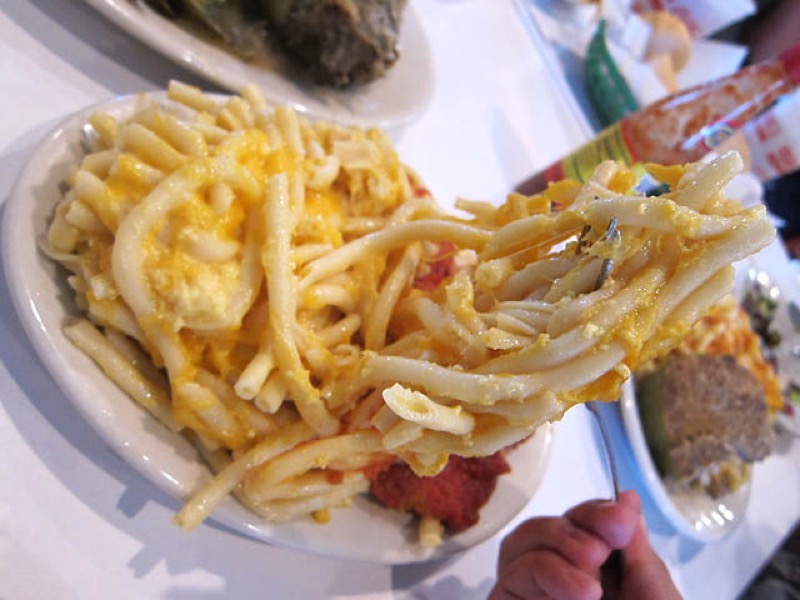
The Onset. Wait the Full Two Hours.
Edibles hit slower and last longer than smoked or vaped cannabis. Onset for a fat-rich edible like this one is typically thirty to ninety minutes, peak effect lands at two to three hours, and total duration runs four to eight hours per the National Institute on Drug Abuse profile of oral cannabis. The single most common edible mistake is eating a second portion at the forty-five minute mark because the first one has not “kicked in yet.”
It will. Wait the full two hours.
If you are still chasing more effect at the two-hour mark, then a second portion is on the table, and you have learned something useful about your tolerance. Cheese is fat-rich, the bechamel is fat-rich, and the THC is suspended in fat the entire time. That means absorption is efficient and the dose lands as expected. Do not exceed the per-serving milligram count by going back for seconds in the same hour.
The Sister Recipes. More Cannabis Cooking From HGH.
- How to make cannabutter
- Cannabis-infused olive oil
- Cannabis hash brownies
- Cannabis chocolate chip cookies
- How to make cannabis gummies
- Pineapple Express cannabutter cake and movie-night menu
Recipe Card. Cannabis Mac and Cheese, Six Servings.
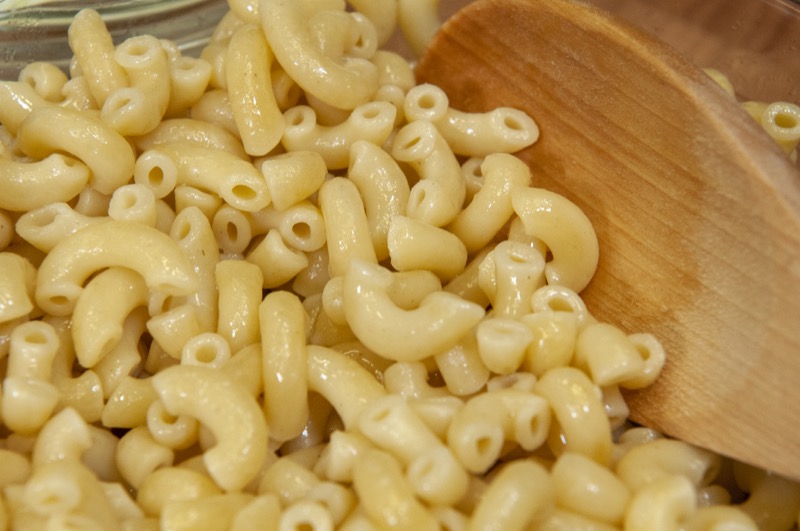
Cannabis Mac and Cheese: Savory Edibles Recipe
Author: Miles Carter
Prep time: 10 minutes
Cook time: 30 minutes (stovetop) or 55 minutes (baked)
Total time: 40 to 65 minutes
Servings: 6
Calories per serving: approximately 540
THC per serving: 5 mg (assumes 10 mg/tablespoon cannabutter)
Ingredients
- 1 pound dry elbow macaroni
- 3 tablespoons cannabutter (10 mg THC per tablespoon, see notes)
- 3 tablespoons unsalted regular butter
- 1/4 cup all-purpose flour
- 3 cups whole milk, warmed
- 1 teaspoon Dijon mustard
- 1/2 teaspoon garlic powder
- 1/2 teaspoon smoked paprika
- 1/4 teaspoon cayenne (optional)
- 1 teaspoon kosher salt, plus more for the pasta water
- Black pepper, generous grind
- 2 cups shredded sharp cheddar (about 8 ounces, freshly shredded)
- 1 cup shredded Gruyere (about 4 ounces, freshly shredded)
- For the baked version: 1/2 cup panko, 2 tablespoons melted unsalted butter, 1/4 cup grated parmesan
Instructions
- Bring a large pot of generously salted water to a boil. Cook the macaroni about 2 minutes shy of package directions. Drain and set aside.
- In a heavy saucepan over medium-low heat, melt the cannabutter and regular butter together until foam subsides.
- Whisk in the flour. Cook 90 seconds, until it smells nutty and looks like wet sand.
- Slowly stream in the warm milk, whisking constantly. Add Dijon, garlic powder, smoked paprika, cayenne if using, salt, and pepper.
- Bring to a gentle simmer, whisking, until the sauce coats the back of a spoon, about 6 to 8 minutes.
- Pull the pan off the heat. Whisk in the cheddar a handful at a time, letting each addition melt before the next. Add the Gruyere the same way. The sauce should be glossy and thick.
- Fold in the cooked macaroni. Taste and adjust salt.
- For stovetop service, eat immediately, dividing into 6 equal portions.
- For the baked version, transfer to a buttered 9-by-13 casserole. Toss the panko with the melted butter and parmesan, scatter over the top. Cover with foil and bake at 375 degrees Fahrenheit for 20 minutes. Uncover and bake 5 more minutes until the top is golden and the edges bubble.
- Cool 5 minutes before portioning into 6 equal servings.
Notes
- Dosing math: This recipe is built for 5 mg THC per serving. The math assumes 10 mg/tablespoon cannabutter. 3 tablespoons total = 30 mg, divided by 6 servings = 5 mg each. If your cannabutter is a different potency, adjust the cannabutter-to-regular-butter ratio so total cannabutter milligrams equal 30, then divide by 6.
- Wait the full 2 hours before considering a second portion. Edibles peak at 2 to 3 hours after ingestion.
- Label leftovers clearly as dosed.
- Do not serve to anyone who has not consented to a 5 mg THC dose.
The Last Bite. Ted’s Verdict, Holding Up.
Ted got the U-Haul to Austin without incident. He still asks for the recipe every time we see each other. The “grown-up Kraft” line is now a running joke in our group chat. The point of that night, I have come to think, was not the cannabis. It was the fact that the dish worked at a microdose, worked at a regular dose, and worked the next morning cold out of the casserole at 7 a.m. while Ted scraped the corners with a fork before pointing the truck east.
The cannabutter matters. The cheese matters more. Salt the water like you mean it.